


The SpaceX IPO has launched despite international liabilities at xAI: SpaceX made its S-1 filing public yesterday, and, despite my note last week about the IPO possibly being canceled and Tesla mooning in response (here), it looks like they’ve overcome any litigation holds due to France’s criminal probe into xAI’s CSAM and anti-Semitic posts. If the IPO roadshow doesn’t start by June 8th, it could indicate that xAI legal liabilities may have stopped it.
The Anthropic deal is the biggest positive takeaway: The S-1 disclosure that Anthropic has agreed to pay $1.25 billion per month ($15 billion annually) to rent xAI’s idle GPU capacity at an estimated 70% operating margin is a huge boon for SpaceX’s short-term earnings. But this isn’t sustainable, as other hyperscalers like Amazon and Google will surely offer better deals once they have sufficient capacity over the next 18-24 months. The S-1 itself notes Anthropic's Amazon deal includes "nearly 1 GWh of new capacity by the end of 2026," meaning it wasn't fully available yet. Colossus was available now.
Anthropic deal assures an extra pump in December from passive funds: Given Musk’s strong push for SpaceX’s early inclusion in the Nasdaq index (which has yet to be confirmed), this setup is perfect: it pumps SpaceX’s profits through Q4 2026, which coincides with the Nasdaq rebalance that will lead to another huge passive-buying squeeze as SpaceX’s float rises due to insiders cashing out (see details in this excellent report). But in light of all the capacity coming online—including Anthropic’s—by mid-2027, it’s doubtful this highly profitable rental deal will last.
Why SpaceX IPO investors will be bag holders of Musk’s failed AI: While the SpaceX S-1 doesn’t break down cash flows by segment, its AI segment’s Q1 EBITDA minus Q1 capex this year is -$8.3 billion, or 3.1x Q1 2025’s -$2.68 billion. The EBITDA minus capex equation is not too far off SpaceX’s stated group free cash flows (refer to Figure 1).
Tesla is mentioned as a co-developer of “Terafab” and “Macrohard”: The estimated cost of a “Terafab”, or a semiconductor fab with 1 terawatt of annual compute capacity, would cost around $80 billion in the US. On top of that, SpaceX states that Tesla will also be a co-developer of “Macrohard”, an agentic AI platform, which helps explain why Tesla guided for 2026 negative free cash flow (FCF) due to planned capex “in excess of $25 billion”.
The SpaceX IPO is clearly aimed at retail, which could backfire: There are around 18 pictures of rockets before one can get to the table of contents in the SpaceX S-1 (Facebook and Slack only had around 4 to 8), and the word “Mars” appears 63 times in the S-1. Word on the Street is that the planned valuation is now $2 trillion, up from $1.75 trillion a few weeks ago, and that all underwriters are using their retail arms as much as possible (e.g., Morgan Stanley’s E-Trade). It’s no surprise that Musk decided to allocate 30% of the IPO to retail investors, versus the usual 5% to 10%. The 15% retail allocation for Pershing Square’s April 2026 IPO to retail investors who quickly flipped their positions, rather than “sticky” long-term holders like pension funds, was blamed for the 18% drop below its IPO price by which founder Bill Ackman.
“Crown Jewel” Starlink isn’t that profitable & faces stiff competition: SpaceX doesn’t include launch costs from its Space segment when disclosing earnings in its Connectivity segment (“Starlink”), which they say had operating margins of 21.3% in 2025, down from 26.4% in 2024. Adjusting for launch costs at an assumption of $17.5 million per launch, however, the 21.3 operating margin reported for Starlink drops to 11.7% when 122 of its satellite launch costs are included. Rivals who are catching up and/or mentioned in SpaceX’s S-1 include Amazon, Eutelsat, OneWeb, Telesat, AT&T, as well as state-backed competitors like China’s Guowang and Europe’s Iris². Starlink’s growth may have peaked out in developed countries, as its aggressive expansion in developing countries—where monthly fees are much lower—led to ARPU dropping by 18% YoY in Q1 2026.
Nasdaq early inclusion is still not set in stone: The only reason I’d buy into the SpaceX IPO is if it were assured that Musk got the Nasdaq index to grant SpaceX early inclusion, which is rumored to happen on the 15th day after the IPO. Because it would force passive funds like QQQ and many others to buy the day after early inclusion was announced, it would cause an epic “buying squeeze”. Details on how I’d trade this below.
SpaceX's IPO is aiming for $80 billion, which could tank Tesla’s stock: Because Tesla has roughly 40% of its shareholder base made up by retail investors, if the SpaceX IPO is hyped up enough by Musk and retail Tesla holders see it as more attractive, it could cause a sell-off in Tesla shares (see details in Figure 2 below). If the IPO gets canceled over xAI criminal investigations, Tesla should rise as the prospects of a merger with SpaceX as a private entity increase, as mentioned in my last report.
Key financial tables are at the end of this report in Figures 3-5, but the link to the complete SpaceX S-1 is here.
===================================================================
Key Points From the SpaceX S-1 Filing
Anthropic is both a saviour for xAI and its potential slayer: The biggest takeaway from the S-1 is positive: Anthropic agreed to pay $1.25 billion per month to rent xAI’s estimated 800,000 GPUs. The $15 billion of annual revenues from renting xAI’s GPUs to Anthropic should generate an estimated operating margin of around 70%, or $10.5 billion. This is as risky as all of Tesla’s Auto division earnings being leveraged on only the Model Y right now: if Anthropic uses its 90-day cancellation rights on its GPU rentals from SpaceX, $10.5 billion of annual operating profit would evaporate from SpaceX. To put this into perspective, had this Anthropic deal been included in its 2025 earnings, SpaceX’s revenues of $18.7 billion would’ve been 80% higher at $33.7 billion, and its operating loss of $2.7 billion would’ve been an estimated $7.9 billion with a respectable margin of 23.5%.
Figure 1: SpaceX Segment Information
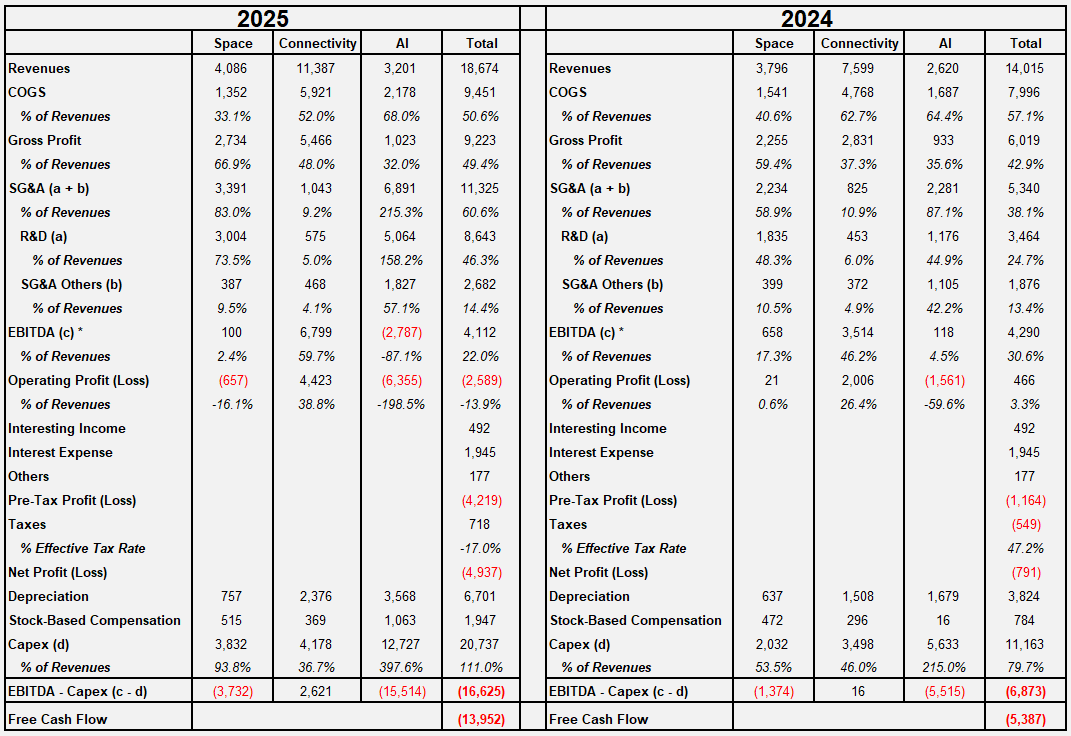
Source: SpaceX & MH research. * Note: EBTIDA = Operating Profit (Loss) + Depreciation & Amortization ex-Impairments.
Why would Anthropic pay a 70% margin for xAI’s GPU cluster? Speed and scale. Anthropic needed a contiguous, 300 MW/100,000+ GPU cluster immediately to train their next frontier model. Building out a data center of that size takes traditional cloud providers 2 to 3 years due to permitting, power substations, and construction. Anthropic is paying a massive premium to buy time, but this could change as the major hyperscalers often have 18 to 36-month lead times for new, massive power substations.
SpaceX books GPU depreciation to R&D to boost gross margins: This could be considered an aggressive accounting trick, but it’s also something Tesla has been doing under US GAAP. By booking $2.38 billion of GPU depreciation into Q1 2026 R&D rather than Cost of Goods Sold (COGS), the AI segment looks like it has a gross margin of 44.3%, rather than a negative gross margin of 66.7%. They justify this by claiming the GPUs are being used to research and train Grok, but since the S-1 says that SpaceX has just started to rent its GPU infrastructure to Anthropic, auditors could likely force SpaceX to move this depreciation into COGS. This is a clear sign that Musk is still obsessed with showing higher “gross margins” than operating margins, just like he does at Tesla.
Shareholders’ equity rose by 13.4x in the 3 months through Q1 2026: Shareholders’ equity at SpaceX was only $2.57 billion at the end of December, but rose to $34.5 billion in Q1 2026. This came on the back of debt and equity financing of $16.1 billion in 2025, and another $22.7 billion in Q1 2026. Some of this debt is quite
Twitter’s MAU is eroding, and xAI’s is weak: Numbers in the S-1 imply Twitter's monthly active users (MAU) have remained largely flat or seen a slight erosion versus competitors like Threads and TikTok. xAI's standalone consumer MAU for Grok is vastly smaller than OpenAI's ChatGPT, which is exactly why xAI shifted its business model to B2B enterprise infrastructure and cloud rentals.
Q1 2026 cash burn at xAI is rising massively: Assuming most of the net non-operating losses at SpaceX are attributed to xAI’s debt burdens, its negative free cash flow was over $10 billion in Q1 2026, or 2.9x that of last year’s Q1, and 58% full-year cash burn of $17.5 billion in 2025. The AI' segment’s negative EBITDA of $0.61 billion, less its capex alone, amounts to negative cash flows of $8.332 billion in Q1 2026 versus negative $2.679 billion in Q1 2025.
Key Exaggerations in the SpaceX S-1 Filing
There are outlandish pumps within the SpaceX S-1, including a human civilization on Mars, but the following items are also noteworthy exaggerations of the outlook at SpaceX that have a more immediate impact:
Overstating Starlink’s profits by 83%: On a pro-forma basis, SpaceX states Starlink’s 2025 operating profit at $1.19 billion, which is a 15% YoY rise from 2024’s $1.03 billion. However, because Starlink excludes launch costs of around $17.5 million, its 2025 operating margin of 36.5%, instead of an actual 11% margin if launch costs were included.
Pitching xAI as a “high-margin” business: SpaceX heavily conflates “AI application revenue” with what is actually just wholesale data center leasing. They pitch the AI segment as a high-margin software/AI agent business, but the reality is that its main source of income will be from Anthropic’s rental revenue from using xAI’s Colossus 1 and Colossus 2 AI data centers. Furthermore, their Connectivity “TAM” (Total Addressable Market) relies on capturing 100% of the theoretical global Direct-to-Cell market, which ignores terrestrial telecom monopolies and regulatory spectrum blockades.
Overstating xAI’s TAM: The S-1 touts a multi-trillion-dollar AI TAM, but its immediate success relies entirely on scaling physical hardware (e.g., GPUs, power units, cooling expenses, etc.). The flaw is the assumption that power grids and liquid-cooling supply chains built by xAI will scale their actual capabilities of achieving artificial general intelligence, or AGI. SpaceX also brushes over the risk that, if AI model efficiency improves drastically (e.g., SLMs replacing LLMs), the demand for massive centralized compute clusters could crash.
Starship to begin launching V3 satellites in 2H 2026: The S-1 aggressively targets the 2H of 2026 for a regular cadence of operational Starship launches carrying the massive next-generation Starlink V3 satellites. This is the hardest proclamation to believe in the outlook section for each of SpaceX’s segments in the S-1, in light of Starship having crashed for its 11th time last week. Going from test flights that crash each time to successful launches with big payloads in the next 6 months is unlikely. It also assumes FAA regulatory clearance for a massive amount of launch volumes, which may not be possible.
Starlink is Risky at Over 60% of Profits
On a pro-forma basis, Starlink is only 38% of SpaceX’s 2025 gross profits, but adjusted for the launch costs that SpaceX excludes from that segment (roughly $17.5 million per launch, or $2.135 billion in 2025), its weight of gross profit drops to 14%.
Starlink’s monthly ARPU (average revenue per user) dropped from $86 per month in Q1 2025 to $66 per month in Q1 2026 and from $91 per month in 2024 to $81 per month in 2025. This was due to Starlink having expanded more in lower-priced emerging markets than in mature markets.
If one adjusts Starlink’s EBIT for the Space segment’s launch costs of around $17.5 million per launch, Starlink only generates 11% operating margins (122 launches in 2025 x $17.5 million/launch = $2.14 billion). To be sure, if launch costs drop by 99% after Starship can actually fly, Starlink’s operating margins may indeed reach 21.3%, but this is hardly worth the lofty valuations being applied by Musk and his bankers to the IPO.
In the consumer segment of Starlink, rivals include HughesNet and Viasat (both of which have seen stagnant or declining revenue as Starlink steals their rural customer base) and Amazon's Project Kuiper (which is still in the deployment phase and not generating meaningful consumer revenue). In the enterprise/government segment, Eutelsat OneWeb is the primary competitor for now. Their growth has been modest, lacking the vertical integration and massive bandwidth scale that drove Starlink's $11.4 billion of revenues in 2025.
The projections for Starlink in SpaceX’s S-1 gloss over capacity exhaustion in high-density areas. Starlink is already facing bandwidth throttling in parts of the US. To grow revenue at the projected rate, they assume uninhibited international expansion, but they face severe regulatory bans or delays in critical high-population markets like India, China, and parts of Africa.
Why Starlink is a crappy business: With an active fleet of over 9,600 satellites and a lifespan of roughly 4 years per satellite, SpaceX must launch at least 2,000 satellites every single year just to replace de-orbiting hardware and maintain current coverage. To reach its 30,000+ goal by 2030, SpaceX must launch thousands more satellites per year. And this needs to be pulled off flawlessly every year in order to offset a constant 3 to 4-year decay rate of Starlink satellites.
With the huge earnings risks, the “pie-in-the-sky” goals, and stated corporate governance that says shareholders’ have zero say, it’s hard to see many long-term institutional investors buying the SpaceX IPO.
How I’ll Trade This Event (Not Investment Advice)
While I warned that the cancellation of the SpaceX IPO might lead to Tesla shares mooning last week (this is still a potential risk, which is detailed here), let’s now envision that the IPO roadshow starts on June 4th (as is already being heralded by brokers in Asia). Here’s what I’m looking for, unless the IPO gets canceled: