

Why Tesla "Robotaxis" Won't Be Driverless For a Long Time
Deep dive into FSD crash data shows incidents becoming more dangerous for Tesla owners, while Tesla's Austin robotaxis already crash 4x more frequently than human drivers.


Many Tesla bulls are scratching their heads these days over why Tesla hasn’t increased the number of driverless robotaxi rides in Austin, where Musk promised to remove the safety drivers by the end of 2025.
While it’s been widely reported that the Austin robotaxi fleet has logged 14 crashes since July over only 820,000 miles traveled (4x less safe than human drivers), little is known about FSD crashes among Tesla owners.
This is because Tesla redacts this data from crash reports, as it’s unsavory and would likely put Musk’s promises of robotaxis for “half the population by the end of the year” further into question.
This report sifts through the data by using filters from what isn’t redacted and finds that FSD used by Tesla owners is becoming increasingly dangerous, not safer than human drivers, as Tesla claims in its safety reports. These are some of the key points:
Tesla robotaxi crash data shows that humans are 4x safer: Data published by the US safety regulator in January showed that human drivers are 3.9x safer than a Tesla “robotaxis” —which have safety drivers in the front seat—while Waymo driverless cabs are 4.7x safer than Tesla’s robotaxis.
FSD crash data is almost as bad and quickly deteriorating: While Tesla forces US regulators to redact most details in their FSD crash reports, isolating FSD-specific situations shows that Tesla owners—and innocent bystanders—are in even greater danger. Since July 2021, there’ve been 28 fatalities and 555 serious injuries related to FSD, making it 1.9x more dangerous than human drivers. Ford’s Pinto was recalled in 1978 after having 28 deaths from its misplaced gas tank, causing the car to catch fire after getting rear-ended.
Musk continues to insist that driverless paid rides have launched: In most US states, robotaxi permits require data proving that the automated driving system (ADS) meets Level 4 autonomy standards. Tesla has yet to submit such data anywhere, yet Musk and his executives at Tesla keep promoting Tesla’s driverless rides in Austin (which are rarely available). Given its track record of being sanctioned for FSD consumer fraud in California last year and its horrible track record of crashes in Austin, it’s highly unlikely that Tesla can expand paid driverless rides any time soon.
Cybercab’s start of production in April will be faked: Since the Cybercab has only 2 seats, and no steering wheel or gas/brake pedals, it must have FSD in order to be functional. Without FSD, Cybercab is useless, but even if FSD were fully autonomous, the Cybercab still can’t drive on US roads: its lack of a steering wheel and pedals violates US safety standards. Many investors are betting that the Cybercab not only launches in April, but that it starts delivering driverless, paid rides. This is close to impossible unless Congress changes the federal safety standards, *and* FSD makes a 20x improvement in reliability.
Regulatory probe weighs heavily on FSD: Section 5 below has details on how much trouble Tesla is in with the US safety regulator. It began with Tesla stalling crucial FSD crash reports, and is now in a situation where Tesla is being forced to explain 8,313 extra FSD crash incidents that they didn’t know existed. If even 25% of these newly discovered 8,313 incidents become verified FSD crashes, it would further skew its safety as being less safe than human drivers. The probe is poking at the heart of FSD, not the crashes, which could be devastating for Tesla. If Tesla can’t prove that its AI isn’t purposely violating traffic laws, a recall of FSD is unavoidable.
Current valuations can’t hold up without driverless robotaxis: On a sum-of-the-parts basis, Tesla should only be worth $27 per share, yet its current stock price is $397. The difference is worth $1.2 trillion dollars, and it’s largely attributed to high hopes of Tesla disrupting the global ride-hailing markets with its low-cost robotaxis. If there are no signs of increased paid, driverless rides by Q2 results, it’s more than likely that the oxygen in this epic bubble begins to seep. Tesla currently trades at an EV/sales ratio of 16x and a negative P/E multiple, versus the auto sector average of 0.47x and 11x, respectively.
This is a data-heavy report with 9 tables, as well as 8 video clips of Teslas on FSD in action.
====================================================================
Introduction—The $1.2 Trillion Robotaxi Illusion
Many Wall Street analysts are forecasting Tesla’s launch of robotaxis by the end of this year and that they’ll gradually scale to high levels by the end of next year. This implies that they’re assuming FSD is capable of Level 4 autonomous driving, which public data from NHTSA fully negates.
I’ve queried one Wall Street analyst about his claims of Tesla being able to scale its robotaxi fleet, and it quickly became clear that he wasn’t analyzing the monthly crash data published by the National Highway Traffic Safety Administration (NHTSA). Moreover, he had no knowledge about the complex regulatory landscape, which makes it impossible for Tesla to operate a driverless ride-hailing service without proof of FSD being a Level 4 automated driving system (ADS).
This report is a product of weeks of sifting through reams of (mostly redacted) crash data reported by Tesla to NHTSA. Aside from showing why Tesla’s self-driving capabilities are still not safe enough for fully autonomous robotaxis, or for use by Tesla owners, this report also has 8 video clips of dangerous near misses.
Musk knows that Tesla’s Full Self-Driving (FSD) technology is a long way off from achieving his endless promises of providing driverless rides for “half the US population”. As detailed below, Tesla cars on FSD have led to 28 fatalities and 585 serious injuries. This is why Tesla has yet to scale its driverless robotaxis in Austin, which has 8 “unsupervised” variants, but only 1 is truly in service, and it hasn’t been seen for over 2 weeks.
Musk nevertheless continues to inflate the illusion of Tesla’s imminent robotaxi launch, promising—for the second straight year—driverless rides for "half the population of the US by the end of the year”.
These empty promises are the key reason why Tesla trades at a $1.4 trillion market cap, when its sum-of-the-parts valuation is only $94.3 billion, or $27 per share. Tesla’s auto business should only be worth $14 per share, based on the average 2026 EV/sales multiple of 0.47x in the auto sector, while its Energy division is only worth $13 per share based on its rivals’ 2029 average PER of 15x.
The robotaxi illusion that Musk has created is, therefore, being awarded a $1.2 trillion valuation, or $350 per share, for something that doesn’t exist. This is both preposterous and stupendous, at the same time, and it explains why Musk has gone to such great lengths to keep the dream going (e.g., 2024’s Cybercab unveiling on a Hollywood set, 2025’s video of a self-delivering Model Y to an Austin customer, and orchestrated “driverless” robotaxi rides in the past 2 months).
But it seems like few investors or blue-chip investment banks like Morgan Stanley have done the research on FSD’s crash rate, which shows how half-baked FSD is as an ADS, and how dangerous it would be to allow FSD-driven robotaxis to scale (Tesla only has one operating driverless robotaxi in Austin, likely only available for Tesla employees or influencers who signed NDAs).
This report shows the unsavory truth behind Musk’s highly orchestrated “self-driving” illusion, and is 100% backed-up by data reported by Tesla to NHTSA. This data is the result of a rigorous multi-layered audit of NHTSA’s SGO Level 2 ADAS crash reports.
For a complete breakdown of the filtering process used to isolate FSD-specific crashes, see the Appendix at the end of this report, which is divided into the following sections:
Section 1: Musk’s “Robotaxi” Dog and Pony Show
Section 2: Behind the Hype: Mounting Robotaxi & FSD Crashes
Section 3: Tesla’s Robotaxi Crashes Highlight the Dangers of FSD
Section 4: FSD Crashes Were 70% More Dangerous in 2025
Section 5: The Mounting Regulatory Squeeze on FSD
Section 6: Tesla is 3 to 4 Years Away From Going Driverless
Appendix: Isolating FSD Crashes Among Tesla’s Redactions
SECTION 1
Musk’s “Robotaxi” Dog and Pony Show
Tesla’s stock hit its all-time high of $492 last December after a couple of its employees uploaded videos of themselves in the back seat of a Tesla robotaxi, with no one driving the car (see Videos 1 and 2 below). Tesla’s Head of AI Software, Ashok Alluswamy, tweeted “And so it begins!” which helped pump the stock.
However, aside from some very well-orchestrated PR stunts with Tesla influencers in late January (see Videos 3 and 4 below), there have been few other signs of any “unsupervised” robotaxi rides for the general public in Austin. This is highly odd, given what Musk said on the Q4 2025 earnings call in late January:
“And we're able to do our first rides with no safety monitor in the car in Austin. These are paid rides. So these are just sort of randomly selected paid rides with no safety monitor. And I think maybe, as of maybe yesterday or so, we actually don't—we don't even have a chase car or anything like that. So these are just cars with no people in them, and no one is following the car in Austin”.
Elon Musk on Tesla’s Q4 2025 Earnings Call, January 28, 2026
Note that he said these driverless rides were “paid rides”, which is key, as most states, including Texas, prohibit paid driverless rides unless the robotaxi operator has an automated driving system (ADS) that meets Level 4 self-driving capabilities.
Because Texas is in a transition phase with its new autonomous vehicle (AV) laws, Musk is capitalizing on this grace period with dangerous PR stunts before May 28, when the Texas Department of Motor Vehicles (DMV) can issue AV permits and start enforcing the new laws (see details here). The first test of whether Tesla’s Full Self-Driving (FSD) technology is an actual Level 4 ADS will therefore be around June, when Tesla should have obtained its AV permit from the Texas DMV.
Also note that Musk said Tesla stopped using a “chase car” behind its driverless robotaxis as of late January. This is because he sensed that retail investors didn’t get that excited after the January videos of a few influencers getting driverless rides because they were followed by chase cars (see Figure 1 below), which isn’t exactly “driverless”.
Instead of reaching a new all-time high as it did in December after Tesla employees posted their driverless rides on Twitter, Tesla’s stock rose only 4% for a day, before dropping by 12% over the following 11 trading days.
Figure 1: Chase Cars With Safety Drivers Gone as of Late January

Source: Electrek.
Video 1: A Tesla Model Y in Austin Without a Driver (Dec-14)
Source: Twitter.
Video 2: Tesla’s AI Chief Rides in a Tesla Robotaxi (Dec-24)
Source: Twitter.
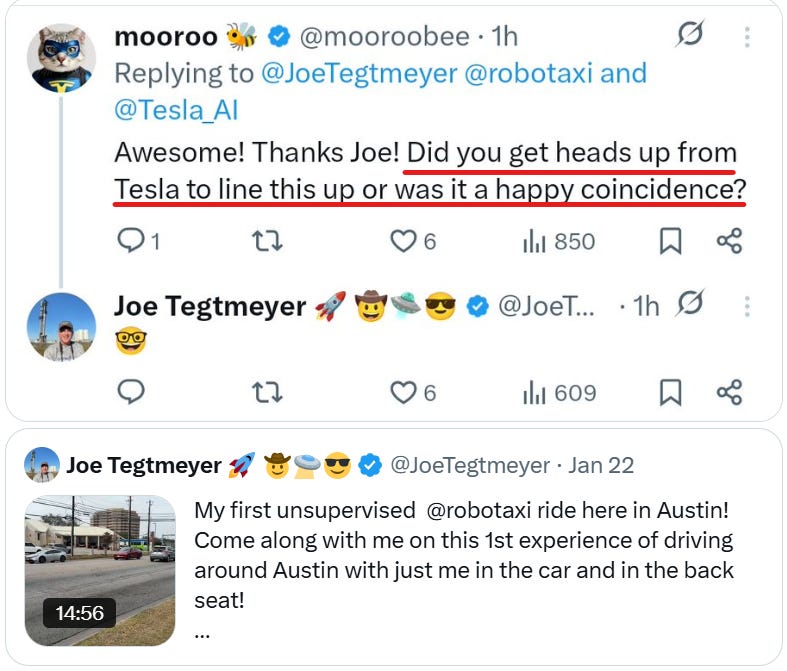
And despite Musk’s claim that the January driverless rides were “paid rides”—accepting money for unsupervised rides is effectively against new AV laws in Texas—one of the influencers all but admitted that he was tapped by Tesla to participate in the “paid driverless ride” event (see Figure 2).
Figure 2: Tesla Influencers Likely Didn’t Pay For Their Rides
Source: Twitter.
Video 3: Tesla Fanboy In a Driverless Robotaxi (Jan-22)
Source: Twitter.
Video 4: Tesla Influencer In a Driverless Robotaxi (Jan-22)
Source: Twitter.
Tesla’s “Robotaxi Show” Becomes More Elaborate and Costly
Musk’s “robotaxi” dog and pony show started wholeheartedly in October 2024, when Tesla unveiled the Cybercab at an event they called “We Robot” (horrible wordplay on an Asimov classic). From this one-time event at Warner Bros. studios, Tesla launched its much more expensive “robotaxi” production in Austin last June and in the Bay Area last September—all with safety drivers in front.
Currently, there are only 45 robotaxis in Austin, while the Bay Area has a full-fledged Uber-type ride-sharing fleet of 315 Model Ys. At an estimated annual cost of $150,000 per “robotaxi” (drivers’ salaries, data processing, insurance, cleaning, etc.), Musk’s dog and pony show is now at a $55 million annual run rate.
Given that this keeps the stock elevated at excessively rich valuations, this is money well spent. The question is how long the market will award a carmaker in decline such nose-bleed valuations for a “robotaxi” business that doesn’t drive itself. Especially if FSD is deteriorating.
Stark Difference Between FSD Perception and Reality
The sections below explain just how severe the recent surge in crashes has been, both among the Austin robotaxi fleet and the Tesla consumer FSD fleet in the US.
The key points, which are based on a deep dive into crash data reported by Tesla to NHTSA, are in stark contrast to what Musk is trying to portray FSD’s capabilities as in Videos 1 and 2 above:
Austin robotaxis are statistically less safe than human drivers: In last month’s ADS crash report from NHTSA, Tesla’s Austin robotaxi fleet racked up 4 extra crashes in just 4 weeks since mid-December, 3 of which were in the first 2 weeks of January. Despite having safety monitors in front, Tesla’s robotaxis now have a track record of 1 crash per 58,571 miles (94,261 km), making human drivers 4x safer (see Figure 3 below).
FSD crashes have become more dangerous: The estimated number of crashes by Tesla drivers using FSD only rose by 5% to 398 in 2025, while, adjusted for fleet miles traveled, the figure showed a 47% improvement from 0.17 incidents per million miles (IPMM) in 2024 to 0.09 in 2025. While the blended IPMM is 0.09, this figure is heavily diluted by low-risk highway driving and does not reflect the much higher failure rate in urban environments. What the regulators are up in arms about, however, is the ratio of fatalities: FSD had 1 death per 36 crashes reported in 2022, which deteriorated to 1 death per 33 crashes in 2025. This spurred a major NHTSA probe of nearly 3 million Teslas last year, and is likely what’s keeping Tesla from doing more driverless robotaxi rides in Texas.
Heavy regulatory scrutiny of FSD: While Musk and his fans insist that Tesla has “solved” FSD, an in-depth probe by NHTSA is unearthing more flaws in the system. After forcing Tesla to search their databases with keywords like “Ran Red,” “Wrong Way,” “Double Yellow”, etc., a whopping 8,313 potential incidents turned up (cumulative FSD crashes are only 1,181).
How Musk’s data manipulation got Tesla into hot water: Tesla is notorious for fudging its Autopilot and FSD “safety” data (famous example here), and hiding whatever shows that its self-driving software is actually dangerous. This finally caught up to Musk last August, as NHTSA launched an investigation into Tesla’s crash reporting methods, which have been as late as 5 months in reporting FSD crashes involving fatalities. All of this looks bad if you’re trying to launch a driverless ride-hailing service.
The Cybercab launch is meaningless without FSD: Musk has hyped the Cybercab—which is so optimized for self-driving that it has no steering wheel or gas/brake pedals—and investors are waiting with bated breath for its scheduled launch next month. But, without FSD, the Cybercab is useless, and even if it had a steering wheel and pedals, few would buy the car, as only sports car connoisseurs buy cars with 2 seats. Moreover, the Texas DMV won’t be issuing AV permits until May, so there’s a lot of upcoming disappointments for Tesla bulls.
Keep reading with a 7-day free trial
Subscribe to Motorhead to keep reading this post and get 7 days of free access to the full post archives.