


Q2 deliveries should be around 443,718: Tesla’s Q2 deliveries are strong and should be as strong as 443,718 versus consensus of 420,000. But this is based on a low base in Q2 2025, when the refreshed Model Y was still in its final ramp-up phase. In Q2 2025, China’s refreshed Model Y was at a weekly production rate of 10,395, which is up by 29% this quarter to date to 13,364 units.
Paying people to buy their cars: Tesla stepped up Q2 incentives via aggressive loan programs in all major markets, including the US, China, Europe, and Asia. The average up-front cost of these low-interest-rate loan programs is around $4,000 per unit, which is adds to spiking component costs.
Q2 profitability will be hit by higher input costs: Despite higher volumes in Q2, higher costs for battery cells and memory chips should more than erase any upside from higher sequential volumes. Lithium hydroxide spot prices are up by 115% YoY to $315/vehicle, while memory prices are up by 131% YoY to $600/vehicle. While this may not sound like a big deal, it amounts to a $458 million sequential headwind to Q2 profits.
Positive indicator for Q3: The current wait time for a Model Y in Tesla’s major markets has more than doubled to 5.8 weeks (see Figure 2), implying strong demand in Q3. This might be due to order cancellations due to European customers’ rejection of their Model Y deliveries with lower-range 4680 battery cells (see details below).
Tesla’s stock is underperforming by record margins: While Tesla underperformed the Nasdaq by 45% until it hit its bottom ($142) in April 2024, and by 37% until its bottom in March 2025 ($222), this is the longest span of underperformance, with 31% outperformance year-to-date. The only reason the stock hasn’t dropped more is due to the (mistaken) consensus that Tesla will be acquired by SpaceX. This is the topic of a coming report that explains how difficult it will be due to regulatory approvals in various countries.
Strong Q2 Deliveries Driven By Higher Incentives
Many Tesla analysts are hiking their Q2 delivery estimates for Tesla to around 420,000 vehicles (+9.3% YoY) due to huge growth outside of the US, which is down by 15.1% YoY so far in Q2, according to Motor Intelligence, despite last year’s low hurdle (the refreshed Model Y was still in ramp-up phase).
I went through the April and May sales numbers by reporting country, and checked shipments from Shanghai and Germany to major export markets in May and June. This led me to a Q2 delivery estimate of 443,718, which is 15.3% higher than my previous estimate of 385,000, 15.5% higher than Q2 2025. Aside from higher incentives and new EV subsidy programs in major markets, much of this growth is off of a low base in Q2 2025, when the refreshed Model Y was still ramping up (it didn’t reach full production until July 2025).
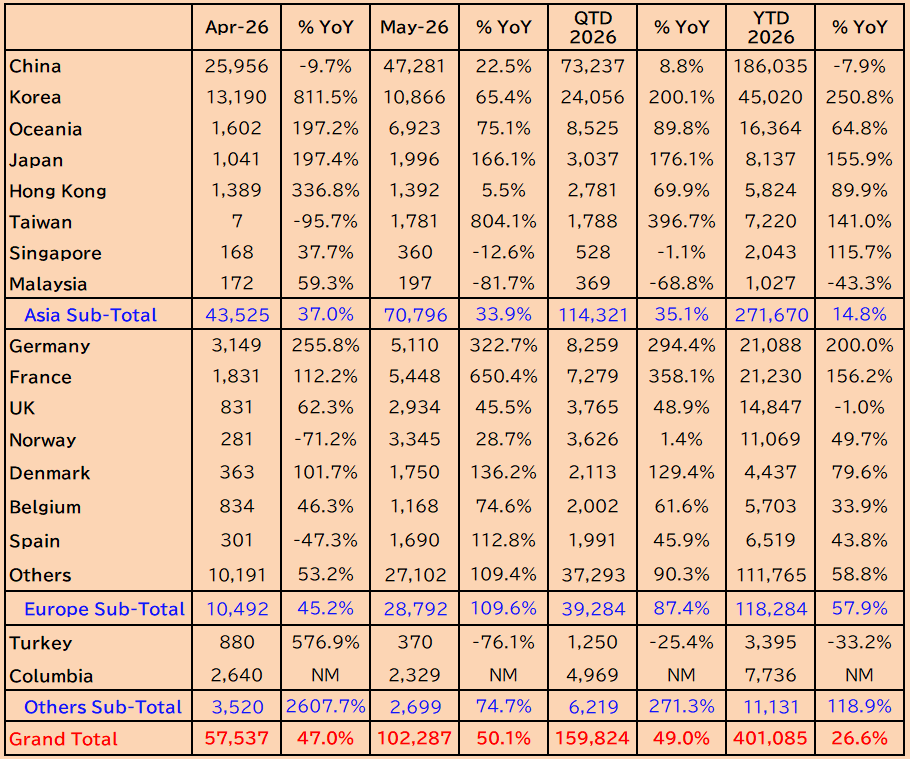
Figure 2 shows most of Tesla’s key overseas markets where their monthly deliveries are published (unlike the US and Canada), and the growth for April and May, quarter-to-date, is huge at 49% YoY. But these main points should be noted as much of the tailwind behind this growth:
Refreshed Model Y was still supply-constrained in Q2 2025: While most carmakers can roll out a model with minor changes quite smoothly, Tesla has to shut down its assembly line for a few weeks, and even then, it takes a long time to return to full production (as was the case with the Model 3’s facelift in 2024). The refreshed Model Y was ramped up more quickly in China than in other regions because Tesla’s Shanghai factory is its most efficient. But Shanghai was still at a weekly production rate of only 10,395 units in Q2 2025, compared to its current run rate of 13,564 units since March. Hence, the sudden 23% YoY spike in retail sales in China in May. In the US, the refreshed Model Y didn’t reach full production until June 2025, and in Germany, it took until August.
Increased EV subsidies fuel growth in many markets: In Figure 2, some of the strongest growth for Tesla sales this year is in countries like Korea, Germany, France, and Japan, where higher EV subsidies are fueling sales (Germany and Canada saw newly introduced subsidies). In Germany and France, the subsidies are as much as $5,000, depending on one’s income, while in Korea, the subsidy rose by 17% YoY to $4,500. At nearly $8,000, Japan has the highest subsidies for Tesla in the world, and this is a 46% spike compared to the 2025 level of $5,250. It should be noted that, to qualify for the EV subsidy in Korea, which is based on the EV’s list price, Tesla dropped the base version price of the Model Y by 6% ($2,000), while the entry-level Model 3 price was slashed by 19% ($6,600).
Special situations in Colombia and Canada: Tesla launched sales in Colombia last November, and the monthly volumes are quite significant, adding an incremental 4,969 units so far in Q2 versus 2025 (see Figure 2). While there is no public data for Tesla’s sales in Canada, deliveries appear to be up by over 71% YoY due to a new EV subsidy of C$5,000 (US$3,600), which was introduced this year. On top of this, Canada struck a trade deal with China, which led to the tariff dropping to 6% from 100% recently, and spurred Tesla to import a huge amount of Model 3’s from China (the Model 3 is only produced in the US and China, but saw weak sales in Canada since April 2025 due to the 25% reciprocal tariff that Canada placed on cars imported from the US).
The downside is that Tesla is selling the entry-level Model 3 at a slight loss in Korea ($27,700) and Canada ($28,200), with razor-thin margins while barely breaking even with its shipments to Europe. The cheapest Model Y in Korea costs $33,000, but net of shipping, tariffs, and taxes, is likely break-even at a factory gate price of $24,237. This is how desperate Tesla is to keep its largest and most efficient plant in Shanghai running near full capacity.
Figure 1: Tesla’s Deliveries by Reporting Countries
Source: Local car associations, government data, and press reports.